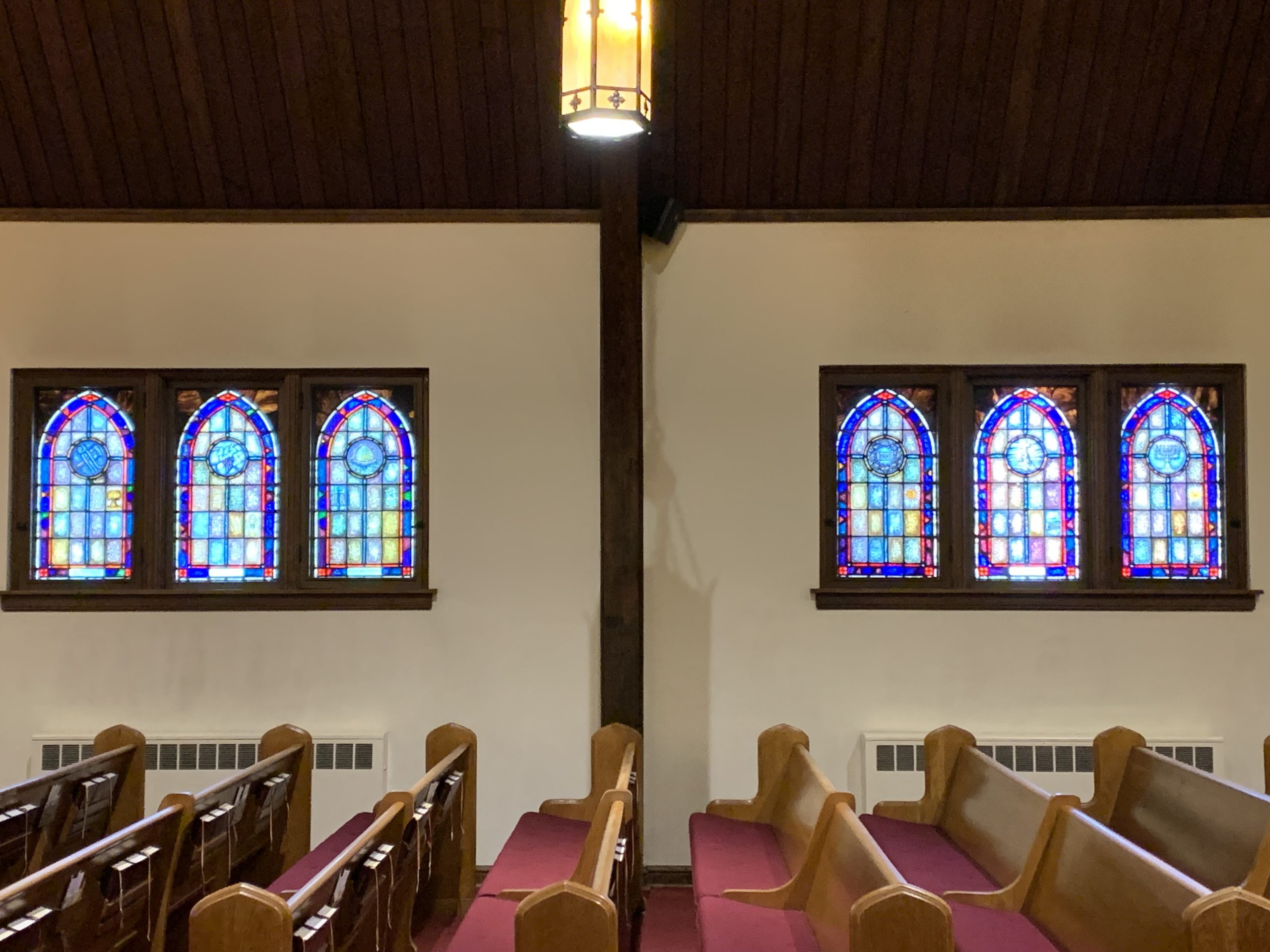
Photos of our Stained Glass Windows and a Brief Description of Their Meaning
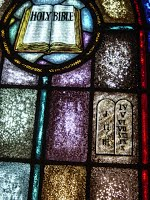
The Holy Bible, God’s Word. Below it is a depiction of the Ten Commandments, the law of God, as they were originally given on two tablets of stone. The first table contains the first three commandments, which concern our relationship to God. The commandments of the second table (4-10) tell us how we should love our neighbor. They reveal our sin and our need for forgiveness and salvation in Christ. For the Christian they are the path we seek to walk upon as God’s design of creation.
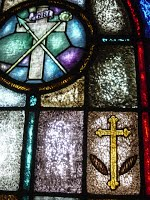
Here is depicted the cross, along with the spear used to pierce Jesus’ side after He died, along with the pole used to offer Him a drink when He cried, “I thirst.” At the top of the cross is the abbreviation “INRI,” which stands for the Latin words, “Iesus Nazarenus Rex Iudaeorum,” in English, “Jesus of Nazareth, King of the Jews.” Below and to the right is a cross with two loaves of bread, indicating that Jesus is the Bread of Life, who feeds and sustains us with His very humanity, His holy body and blood in the Holy Eucharist. After His atoning death, a soldier pierced Jesus’ side and out came a flow of blood and water.
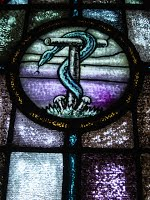
“As Moses lifted up the serpent in the wilderness, so must the Son of Man be lifted up, that whoever believes in Him may have eternal life.” (John 3:14-15)
One of the great Old Testament foreshadowings of Christ is found in Numbers 21, when the disobedient Israelites are plagued by venomous snakes. God instructs Moses to make a serpent from bronze and place it on a pole. God tells Moses to tell the people that any who are bitten may look to the bronze snake and be healed and live. This points forward to Christ, who on the cross became sin for us to suffer the punishment we deserve for our sins. As we look to Christ and to His cross, we too shall live. The Old Testament is to be interpreted as the book of Christ, with Jesus as its ultimate meaning in prophecy, type, and foreshadowing.
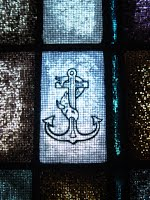
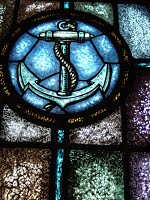
“We have this as a sure and steadfast anchor of the soul, a hope that enters into the inner place behind the curtain.” (Hebrews 6:19)
The anchor is a popular Christian symbol for hope. The fish on the anchor on the left represents Christ, as the Greek word for fish, “Ichthys,” also is an acrostic in Greek for “Jesus Christ, God’s Son, Savior.” The fish also reminds us that some of Jesus’ disciples were fishermen by trade and that as Christians, we, too, are called to be “fishers of men.” Likewise it reminds us of life in Christ just as the prophet Jonah emerged from the great fish, so also Christ rose from the dead on the third day. In the early church, “ICHTHUS” was used as a “password” to Divine Services in times of persecution under the Roman empire. It is a reminder to be prepared wisely for times of persecution and to hold together with the church.
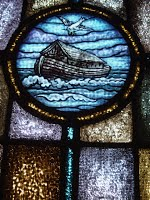
Noah’s Ark, in which God saved believing Noah and his family, eight souls in all, from the flood. The dove of peace that brought Noah news of the flood’s recession is also depicted. The ark is also a symbol of the church; while Holy Baptism is prefigured by the floodwaters, as sin and wickedness are washed away in the cleansing waters of Baptism. The historic Easter Vigil also speaks in these terms as it recalls the foreshadowings of Baptism and the Resurrection of Christ in the Old Testament.
Luther’s Flood Prayer (from his baptismal rite):
Almighty and eternal God, according to Your strict judgment You condemned the unbelieving world through the flood, yet according to Your great mercy You preserved believing Noah and his family, eight souls in all. You drowned hard-hearted Pharaoh and all his host in the Red Sea, yet led Your people Israel through the water on dry ground, prefiguring this washing of Your Holy Baptism. Through the Baptism in the Jordan of Your beloved Son, our Lord Jesus Christ, You sanctified and instituted all waters to be a blessed flood, and a lavish washing away of sin. We pray that You would behold (name) according to Your boundless mercy and bless him with true faith by the Holy Spirit that through this saving flood all sin in him which has been inherited from Adam and which he himself has committed since would be drowned and die. Grant that he be kept safe and secure in the holy ark of the Christian Church, being separated from the multitude of unbelievers and serving Your name at all times with a fervent spirit and a joyful hope, so that, with all believers in Your promise, he would be declared worthy of eternal life, through Jesus Christ, our Lord.
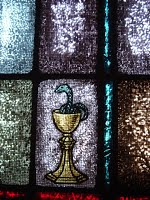
The chalice with the snake is a symbol for the Apostle John (son of Zebedee). According to legend, John was given a cup of poisoned wine to drink. Before drinking it, however, he blessed the cup, and the poison departed the cup in the form of a serpent. In the Lord’s Supper we receive the medicine of immortality and the antidote to death in the body and blood of Jesus.
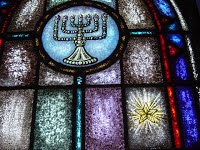
The lampstand is another symbol for the church. For example, we read in the Book of Revelation, “As for the mystery of the seven stars that you saw in my right hand, and the seven golden lampstands, the seven stars are the angels of the seven churches, and the seven lampstands are the seven churches.” (Rev. 1:20). God’s Word is a lamp unto our feet and a light unto our path in the darkness of this world and as we face temptation from the devil, the world, and our sinful nature. Traditionally, the processional torches flank the lectern in the chancel as a reminder that the Scriptures are such light for us. Jesus Christ is the Light of the World, the light no darkness can overcome.
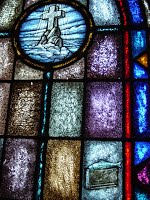
Christ is our rock (1 Corinthians 10:4) amidst the stormy waters of life. And Jesus promises that “on this rock” (this confession of Him as Christ), “I will build my church,” as He told St. Peter (Matthew 16:18). Another one of the apostles who was once a fisherman was St. Simon the Zealot. His symbol of a fish and book is also pictured here. The world is constantly changing but the Jesus Christ is the same yesterday, today, and forever.
Built on the Rock the Church shall stand
Even when steeples are falling.
Crumbled have spires in ev’ry land;
Bells still are chiming and calling,
Calling the young and old to rest,
But above all the souls distressed,
Longing for rest everlasting. [LSB 645, stanza 1]
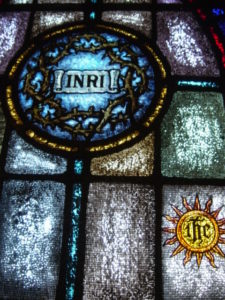
The crown of thorns, which depicts Christ’s passion and suffering for us, again with the INRI abbreviation (see above). Also, the “Sun of Righteousness,” another name for Christ, with the “IHC” (sometimes rendered “IHS”) which stands for the Latin, “Jesus Christ, Savior.”
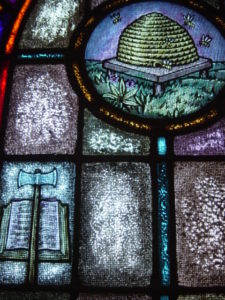
The beehive is a symbol for the church. The people of the church work together diligently and zealously for the common goal of bringing not honey, but the sweet message of the Gospel to all people in our various callings in life. Below is the symbol of the apostle St. Matthias, who was called to take the office previously held by Judas Iscariot. He is symbolized by an open Bible and double-bladed battle-axe because he is said to have been beheaded after persecution in his missionary work.

Fruit is a rich symbol in Christianity, both as a representation of good works, i.e., “the fruits of faith,” and also in pointing to the fruit of the vine, wine, which is used in the holy Sacrament of Christ’s Body and Blood. The Lord works through His good creation to bless and sustain us.
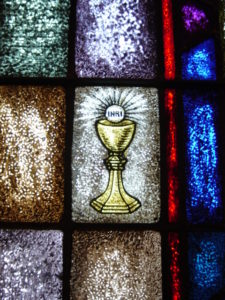
The chalice and host is a common symbol for Holy Communion, the holy Body and Blood of Christ given in the Divine Service. It is how the flock is fed and knit together. Jesus is the Vine and we are His branches.
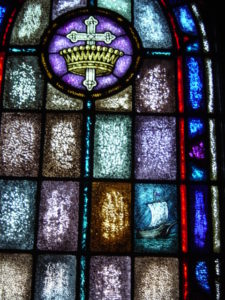
Christ is our king. His cross is shown with a crown. The sailboat underneath is a symbol of the apostle St. Jude, who was a fisherman and missionary. The boat is also a symbol of the Church.
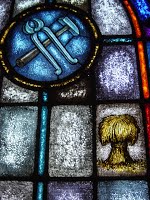
The tools of a carpenter remind us of our Lord’s human nature and the vocation of his legal guardian Joseph. The haystack reminds us of Jesus’ words that the “harvest is plentiful” for God’s kingdom, though the “laborers are few” (Matthew 9:37). The Lord uses each of us in our daily callings in life with our neighbor.
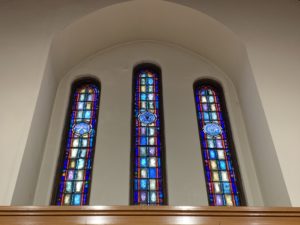
These windows over the altar at Grace are smaller and harder to see, but the center one contains Martin Luther’s seal (or Luther Rose), which is explained here. The one on the right depicts God as our “Mighty Fortress,” which is also a favorite Lutheran hymn based on Psalm 46. The left window shows trumpets of praise and the words “Praise the Lord,” as we anticipate the final trumpet.
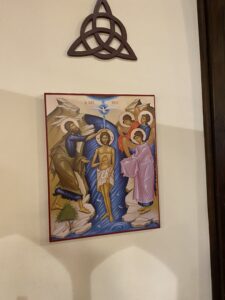
While not stained glass, we additionally mention the recent addition of the theophany icon (Baptism of our Lord Jesus at the Jordan River) with Holy Trinity symbol (triquetra). It was dedicated to the glory of Christ March 15, 2026. Positioned on the wall next to the side nave entrance, it is a reminder to all who enter and leave the sanctuary of their being united with the Holy Trinity through Christ in the sacrament of Holy Baptism. It is our identity in Christ. The Baptism of Jesus at the Jordan is a clear epiphany of all three persons of the Blessed Trinity simultaneously in time. Likewise we see the great exchange of Christ receiving a Baptism for sinners, while our Baptism into Christ means we receive His holiness. We then as baptized believers have the privilege to serve as priestly servants of God praying to the Father in Christ’s name and proclaiming Christ to our neighbor in the world by strength of the Holy Spirit.